Wednesday, 13 February 2013
Winter minestrone soup with borlotti beans and bacon
Being February, it is still quite cold outside. I find I really must have a hot lunch to keep my spirits up. Often, I will make a large pot of this healthy soup and parcel it out by the bowlful over the course of the week. But best of all, it is wonderful if I can convince my children that this is their after school snack - warming and full of Organic vegetables. This recipe can easily be adapted to a vegetarian soup by removing the bacon, but if you aren't a vegetarian, it does give a depth of flavour that satisfies the soul.
A few words about borlotti beans: these protein packed beans have a creamy texture when cooked and add a nutty flavour to your dish. If you are unable to find tinned borlotti beans, cannellini beans can be substituted. The American equivalent to borlotti beans are cranberry beans.
1 T olive oil
1/2 cup bacon, diced or lardon
1 onion, diced
2 carrots, sliced
2 celery stalks
1 leek, sliced
1 tin borlotti beans, drained
2 garlic cloves, crushed
Chicken stock *
1/2 red pepper, diced
small bit of crushed chili or hot red pepper (optional)
thick egg noodles or pasta
4 leaves from a savoy cabbage, thinly sliced
grated Parmesan cheese
Saute the bacon in olive oil until the fat is rendered from the meat. Add the onion, carrots, celery, leek and sweet the vegetables until tender. Add the garlic and drained borlotti beans to the pot. Top up the pot with homemade chicken stock or water with a vegetable stock bouillon powder, such as Marigold. Once the carrots have softened, add the red pepper and egg noodles. When those are just about al dente, add the Savoy cabbage. Serve in a big bowl with a grating of Parmesan cheese on top.
I also like to leave out the noodles and pour the soup over high quality stale French or Italian bread for Ribollita. Another lovely option is a nice green dollop of fresh pesto on the top of the soup.
* I always have some stock in the freezer made with my leftover roast chicken. Here is my recipe for chicken broth: http://www.lifeatmybench.blogspot.co.uk/2013/01/chicken-noodle-soup.html
Tuesday, 5 February 2013
15 minute Games
Remember when we used to go on holiday and there was no TV, no handheld electronics and no Internet? It is very hard to replicate it. We've had a family property in New Hampshire until this year where we have tried to give this experience to our children. My sister and I have banned all modern forms of entertainment for our children, until cocktail hour when we'd put a DVD on the laptop for them (no need to be monastic!).
But, we have had a great time playing an assortment of 15 minute games around the dining room table on rainy mornings or late at night. Here are a few family favourites that you may or may not know about. Click on the name of the game to go to the Amazon.co.uk site or go to the Amazon list below for the US version:
Bananagrams: Really fun and completely addictive game. Great for all ages.
Blokus: Really fun and quick strategy game. Great for spacial perception.
Quoridor: My children beat me at this regularly. Think empowerment!
Tantrix: A bit more complex, but keeps them busy a bit longer!
Uno: I loved playing this with the children when they were very young. Still fun!
Rory's Story Cubes: You don't need these to play the story game, but it sure is fun to roll the dice!
Hoyles Card Game Rules: This book and a deck of cards will keep you busy for weeks.
For more information on these games, look at my list on Amazon.com: 15 Minute Games
And if all else fails, get them to the table with the After Eights game.
Friday, 1 February 2013
Wild Rice Salad
This is a bit of an impromptu posting: I just threw together this salad for lunch and it tasted so good I had to share it with you. This is what I call and open-palm recipe; in other words there aren't really any measurements, just a bit of what you have in your refrigerator. Take the recipe as a starting point and be creative.
Wild Rice Salad:
cooked wild rice
chopped yellow pepper
dried cranberries
chopped red onion
diced beetroot
chopped flat leaf parsley
crumbled pecans (6 - 8)
drizzle of olive oil
drizzle of aged balsamic olive oil
drizzle of red wine vinegar
What would you add to this?
Wednesday, 30 January 2013
No Knead Bread
In 2006, Mark Bittman wrote an article in the New York Times about Jim Lahey of Sullivan Street Bakery's No Knead Bread recipe. This article sparked a bread making revolution in America. My mother's eagle eye spotted the article and cut it out for me. She sent it off to me in London saying, "You must try this recipe, it is magic!" Try it I did, and yes, it is magic. So, now I say to you, dear reader: "You must try this recipe, it is magic!" Imagine, anyone of any level of bread making experience can make the most beautiful loaf of bread in your home kitchen! And you don't need to be nervous about your kneading skills.
We have photographed the whole process for you to help illustrate how easy this recipe is. The most important thing is to realise it will take 18 - 24 hours to ferment, so plan to make your loaf a day in advance.
Mark Bittman reveals the No Knead Bread
Jim Lahey's No Knead Bread
I like to make my bread with some wholemeal flour to give it a bit more fiber. My recipe has slightly different weights and measurements to Jim Lahey's original recipe. In the UK, bread is best made with strong flour which has a higher gluten content. In America, I favour King Arthur Flour, which is a great all-purpose flour. You could also combine the flour measurements and use their White Whole Wheat product.
180 g / 1 Cup (strong) whole-wheat or wholemeal flour
310 g / 2 Cups (strong) white flour or All-Purpose flour like King Arthur's
1/2 tsp yeast
1 3/4 tsp table salt
345 ml / 12 oz water
Place all of the dry ingredients in a large bowl.
Whisk them together so they are thoroughly mixed.
Add the room temperature tap water to the dry ingredients.
The dough will come together into a rough and slightly sticky batter with a quick stir. Cover with cling film and allow to ferment for 12 - 18 hours (even up to 24 hours).
The dough will become quite loose and wet after 18 hours.
Turn your oven onto 225C/450F and place a covered casserole dish into the oven to heat for 30 minutes. (Others have used covered Pyrex dishes, ceramic dishes with lids or Aluminium casseroles. The most important element is that it has a cover.)
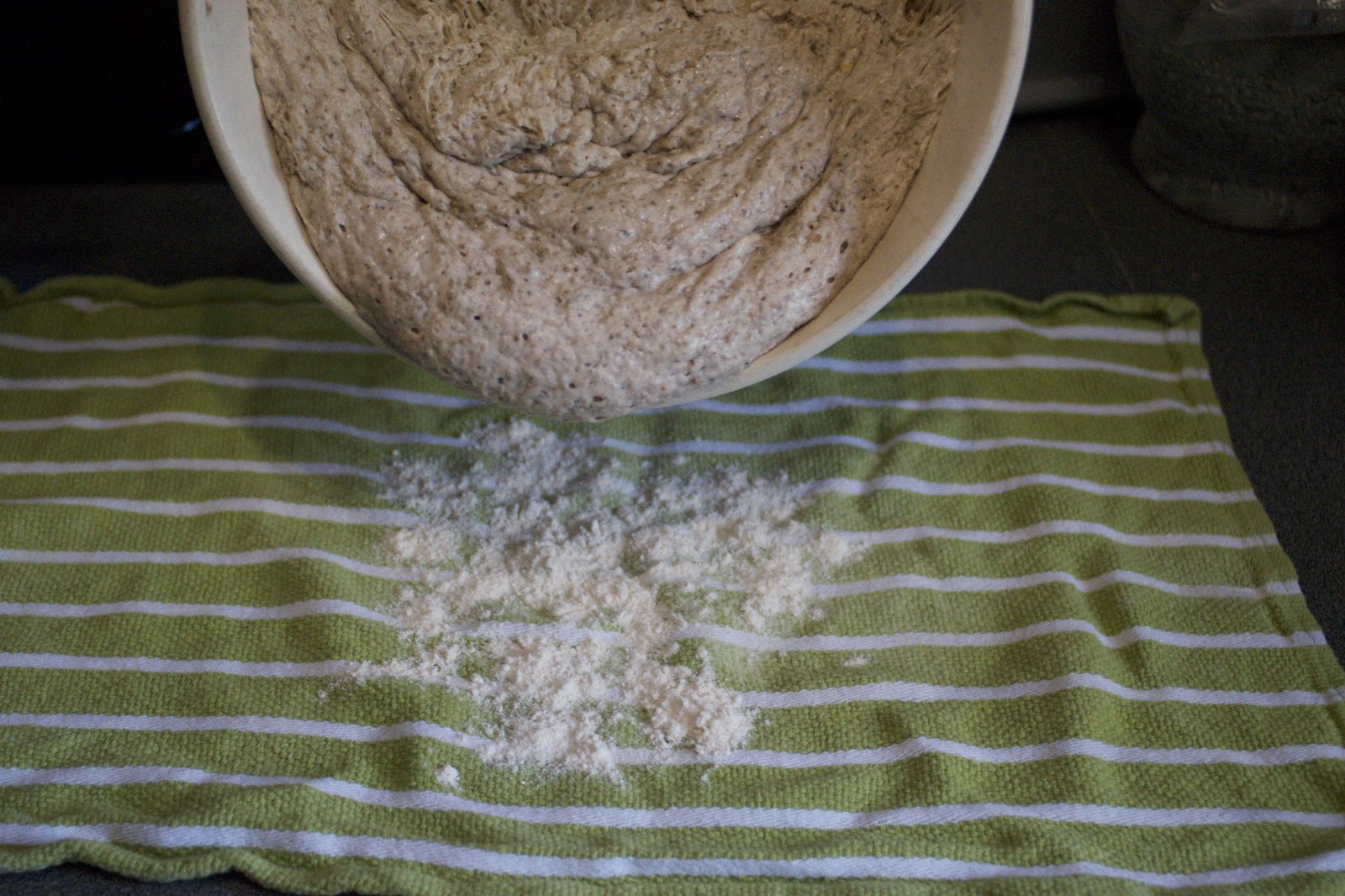
Turn your dough out onto a liberally floured tea towel.
Very gently shape the dough into a round loaf and allow to rest while the pot heats in the oven. Do not knead it! You've made a lovely structure and kneading will ruin it.
Gently place the dough into the VERY HOT lidded casserole dish. Some people put a bit of cornmeal or bran on the bottom of the pot to prevent sticking, but I haven't found this is necessary. Put the lid on and place it back in the oven.
Bake for 30 minutes at 225C/450F with the lid on. After 30 minutes, it will look like this.
Remove the lid and bake for a further 15 minutes at the same temperature. It will look like this.
Allow the loaf to cool for an hour before cutting into it. This will be the biggest challenge of the entire recipe.
Once you've made this recipe you can start to make lots of variations. Try onion, cheese and rosemary or cranberry and pecan. Simply add those ingredients at the beginning of the process. What variations would you make?
Sunday, 27 January 2013
Roast Buffalo Cauliflower Salad
My friend Stephanie says I can't follow a recipe, EVER. There is some truth in that. Despite having over 100 (150?) cookbooks, I rarely open them to follow a recipe. This may be a perfect example of how I'll take an idea and run with it.
For those of you who are unfamiliar with Buffalo Chicken Wings, they were first served at The Anchor Bar in Buffalo, NY in 1964. The wings were fried, tossed in a buttery hot pepper sauce and served with a blue cheese dressing and celery sticks. Buffalo wings are now a favourite bar snack and a popular dish to serve when watching America Football. This makes a great vegetarian alternative to Buffalo Chicken Wings.
Roasted Buffalo Cauliflower Salad
1 head cauliflower
2 T olive oil
1 - 2 T hot sauce
salt
Handful of each of the following:
rocket/arugula
crumbled blue cheese (Maytag in the USA or Roquefort in Europe)
2 stalks of celery, sliced diagonally
toast pecans
olive oil
red wine vinegar
Pour the olive oil and hot sauce into the bottom of a large bowl. Separate the cauliflower into small florets and drop into the bowl. Toss it around to distribute the olive oil and hot sauce. Drop it onto a shallow roasting tray and sprinkle with salt. Roast for 20 minutes at 200C/400F until the edges get toasty brown. This may take a bit shorter or longer depending on how hot your oven runs. Take it out of the oven and let it cool.
Build you salad in a wide bowl or platter with a layer of rocket/arugula on the bottom, followed by the roast cauliflower. Tuck slices of celery around the platter and crumble some blue cheese on top. Drop a few pecans over the salad. To dress it, I recommend drizzling some nice olive oil across the top and give it a splash of red wine vinegar. Don't toss it, just serve it as you have constructed it.
Let me know what you think of my new vegetarian twist on a Buffalo classic.
For those of you who are unfamiliar with Buffalo Chicken Wings, they were first served at The Anchor Bar in Buffalo, NY in 1964. The wings were fried, tossed in a buttery hot pepper sauce and served with a blue cheese dressing and celery sticks. Buffalo wings are now a favourite bar snack and a popular dish to serve when watching America Football. This makes a great vegetarian alternative to Buffalo Chicken Wings.
Roasted Buffalo Cauliflower Salad
1 head cauliflower
2 T olive oil
1 - 2 T hot sauce
salt
Handful of each of the following:
rocket/arugula
crumbled blue cheese (Maytag in the USA or Roquefort in Europe)
2 stalks of celery, sliced diagonally
toast pecans
olive oil
red wine vinegar
Pour the olive oil and hot sauce into the bottom of a large bowl. Separate the cauliflower into small florets and drop into the bowl. Toss it around to distribute the olive oil and hot sauce. Drop it onto a shallow roasting tray and sprinkle with salt. Roast for 20 minutes at 200C/400F until the edges get toasty brown. This may take a bit shorter or longer depending on how hot your oven runs. Take it out of the oven and let it cool.
Build you salad in a wide bowl or platter with a layer of rocket/arugula on the bottom, followed by the roast cauliflower. Tuck slices of celery around the platter and crumble some blue cheese on top. Drop a few pecans over the salad. To dress it, I recommend drizzling some nice olive oil across the top and give it a splash of red wine vinegar. Don't toss it, just serve it as you have constructed it.
Let me know what you think of my new vegetarian twist on a Buffalo classic.
Monday, 21 January 2013
Chicken Noodle Soup Recipe
In the height of this flu and cold season, nothing makes me feel better than a bowl of homemade chicken noodle soup. In fact, I can crave it acutely. And when London turns snowy and wintery, I positively must have it. If you are like me, may I suggest you put some of the extra stock in the freezer for one of those days you are feeling low and just need that quick fix of "feel better soup".
This recipe is based on the one my Grandmother taught me when I was a child. You can read about it in my post entitled, "Grammy Wyckoff's Chicken Noodle Soup". If you don't have the time to make homemade egg noodles, find some nice sturdy noodles with a bit of bite. Even the pickiest of my children slurp this soup right up. Serve it with a bit of my No Knead Bread.
Chicken Stock
If you are using a left over roast chicken, pick the meat off and reserve. Otherwise, place a whole Organic or Free Range Chicken in a large stock pot.
1 large onions, quartered
2 cloves garlic, slightly crushed
2 carrots, quartered
2 celery stalks, cut in thirds
1 leek, cut in large chunks
1 lemon cut in half and given a bit of a squeeze
1 heaped tablespoon of Marigold buillon powder or Knorr stockpot tub
1 bayleaf
Any fresh herbs you might have: parsley, sage, thyme, rosemary, bay leaf
(Potato water if you made mash with your roast)
From a Roast Chicken: Pick the all visible meat off of the chicken carcass and put in the refrigerator for later. In the largest stock pot you have, put in the vegetables listed above, the ones from the bottom of the roasting pan, any fat and bones, burnt bits, etc. (Trust me, this makes the richest stock and will be strained later.) Cover the whole thing with water and cook covered at a low simmer for about an hour. (This could also be done in a large Crockpot.)
From a Fresh Chicken: Add all of the ingredients and bring to a light simmer for 1 1/2 hours. If the temperature gets too high the chicken will get tough. After 1 1/2 hours pull at the drum stick. If it comes away easily, remove the the whole chicken from the pot and set aside to cool. The chicken should be firm and the leg start to fall off. Reduce the stock further to intensify the flavor. You'll be able to make lots of additional dishes with the poached chicken.
Let the pot cool. Place a large bowl in the sink and line it with a large colander. Scoop all of the bones and vegetables into the colander and let it drain. Discard these items, they have done their job! Now pour the remaining items into the colander strain out the remaining bits and pieces. Finally, refrigerate this stock with some cling film over the top. Once it has really cooled down a layer of fat with float to the surface. Lay a paper towel on top and the fat will adhere to the towel. Throw it away. The stock can be frozen in portions for later use or saved for noodle soup. Tip: Pour some stock into those ice bags before putting it in the freezer. You can add them to sauces for quick flavour.
(For a more Asian flavour, add a knob of ginger, lemongrass and lime leaves.)
Noodle Soup
1 medium onion, diced
2 carrots, sliced
2 celery stalks, sliced
1 leek, sliced
1 T olive oil
2 liters/1 quart of chicken stock
1 1/2 cup diced cooked chicken
1 1/2 cups uncooked thick egg noodles (recipe follows)
In a medium sized pan, saute the vegetables in the olive oil. Add a portion of the chicken stock. Simmer the vegetables until they become soft. Turn up the heat to a light boil. Add the chicken and egg noodles. Cook until the noodles are tender, but not too soft. (If you don't have the time or inclination to make noodles, try cut up pasta, rice, wild rice or barley.) Adjust salt and pepper to taste.
Egg Noodles
I use a classic pasta recipe for these. You can double the recipe if you want to make extra noodles for another day. When my grandmother made them, she would drape the noodles over a broom handle as they dried. I've cut mine a bit shorter to appeal to my children.
100 grams (scant cup) 00 Pasta flour
1/2 tsp salt
1 medium egg
1 tsp olive oil
1 tsp water
Combine the ingredients into a food processor.
1) In a food processor, add all of the ingredients and blend until the dough resembles a rough wet sand. If you pinch it, it should come together. (This can also be done by hand by making a well in the centre of the flour and incorporating all of the ingredients, but it won't have the look of sand.)
2) Bring the dough together into a ball and let rest with cling film for 5 minutes.
3) Roll the dough out on a lightly floured board. I like my noodles a bit thicker, but the will swell when they are cooked.
4) Cut the noodles vertically and then horizontally.
5) Toss the noodles with a bit more flour to prevent them from sticking together as they dry.
Let me know how you like it. With the rest of the chicken, I made a Chicken, Leek and Mushroom pie, as well as some risotto. That has kept us for almost a week of meals. What would you make with the leftover broth and chicken?
Wednesday, 16 January 2013
Slow Roast Lamb followed by Lentil Stew
![]() |
| Lamb and Lentil Stew |
Fork Tender Slow Roast Lamb
15 minutes to prep, 3 1/2 - 4 hours to cook
Serves 4, plus leftovers for the stew
(Doubles easily)
Serves 4, plus leftovers for the stew
(Doubles easily)
1/2 C white wine + 1/2 cup water
1 heaped Tbsp tomato puree (paste)
1 onion, sliced in wedges1 heaped Tbsp tomato puree (paste)
2 lb/1 k boneless lamb shoulder (but any size is fine)
3 cloves garlic, left in their skins
3 sprigs of thyme
drizzle of aged balsamic vinegar over the lamb
Salt and Pepper
To serve:
parsley
pomegranate seeds
1 to 1 1/2 cup course bulgar wheat and 1 tsp salt
Combine the white wine, water and tomato puree in the bottom of casserole dish. Add the onion wedges, thyme sprigs and unrolled the boneless leg of lamb into the dish. Nestle the garlic cloves around the lamb and liberally season with salt and pepper. Drizzle the top with aged balsamic vinegar. Cover the dish and put in a 150 C/300 F oven for 1 1/2 hours. Check the lamb at this point and add more water and wine if needed. It should be starting to get tender, but still firmly together. Reduce the oven to 100 C/200 F for an additional 2 - 2 1/2 hours. At this point you can keep it warm until you are ready to serve it. It will be ready when in gently falls apart when you prod it with a fork.
About 30 minutes before serving make the bulgar wheat. Place 1 to 1 1/2 cups of coarse bulgar wheat into a large glass bowl. Using the same cup or mug, add twice the amount of boiling water to wheat in the bowl with 1 teaspoon of salt. Cover with a plate and set aside. After about 10 minutes, pull a fork through the bulgar to fluff it up. At this point you can check to see if it is ready. If it is still a bit crunchy add a bit more boiling water. If it is fully saturated, but there is too much water, drain the excess out. Check the seasoning.
To serve: Put the roast on a cutting board and remove all of the fat. Gently pull apart the lamb and put in a serving dish. Top the lamb with pomegranate seeds and chopped parsley and serve with bulgar wheat. Reserve all of the juice, onions and garlic in a large measuring cup for tomorrow's lentil soup. Cover with cling film and place in the refrigerator. A layer of fat will solidify on the top overnight. Also keep back a 1/2 cup of bulgar for the soup. (In a pinch you can add dried bulgar to the soup.)
Lentil and Lamb Stew
1 Tbsp olive oil
1/2 large onion, diced
2 carrots, diced
2 celery stocks, diced
1 cup green or brown lentils
shredded leftover lamb
Beef or Vegetable Knorr Stock Pot
2 - 3 cups water
Left over from the roast:
juices from the pan
whole garlic, squeezed out of their skin
Additions to serve:
handful of baby spinach
1/2 cup leftover bulgar wheat
plain yogurt
harissa paste
fresh lemon juice
In a soup pot saute the onion, carrot and celery in 1 tablespoon of olive oil. Meanwhile, skim the fat off the leftover pan drippings from the roast and squeeze the garlic cloves from their skin. Once the vegetables start to soften, add the pan juices, Stock pot/cube, lentils and leftover shredded lamb. (If your lamb is very soft, you could wait until the end of cooking to add the meat.) Cook on a slow heat for about an hour, or until the lentils are soft. Before serving, add the cooked bulgar wheat, baby spinach and a squeeze of lemon to taste. Garnish each bowl with a spoon full of plain yogurt and a few dollops of harissa paste. (If you have access to fresh harissa paste, it makes all the difference.)
For my veggie and vegan friends, leave out the lamb (obviously) and use vegetable stock. To make the stew more complex, add finely chopped porcini mushrooms and a drizzle of balsamic vinegar.
Subscribe to:
Posts (Atom)